|
This is version 6.07 of the Imperial "Frequently Asked Questions". It's intended to share Imperial history with visitors to my Imperial web site, using a traditional Internet format. It's also intended to give Imperial Mailing List (IML) members an opportunity to contribute their knowledge of Imperials to the improvement all Imperial web sites and to history! Obviously, there are now more questions than answers! Please feel free to contribute to ANY question, including corrections - and to pose other questions. Please also consider volunteering as an editor of this FAQ - all contributions will be edited to maintain a single style as much as possible. Chris Hawkins has contributed significant material and editing suggestions to this FAQ. Other contributors are recognized at the end of the FAQ and with the section contributed. If you recognize one of your prior contributions and don't see your name - let me know! What is an Imperial? The Imperial was the flagship luxury - and sometimes performance - car produced by Chrysler Corporation between 1924 and 1994. The first "Imperial Sedan" and "Crown Imperial" models were undistinguished, but as introduced in 1925, the 1926 model Imperial 80 was a high performance six cylinder intended to compete with Packard, Cadillac, Lincoln and Pierce Arrow. In 1928, the L80 Imperial with the 112 hp "Red Head" engine was the most powerful US production car . With a 136" wheelbase and bodies by LeBaron, Dietrich and Locke, the Chrysler Imperial was a attractive and prestigious car. The 1931 Imperial CG with an eight cylinder, 135 hp engine continued this tradition.
The 1931 Imperial CG 384.5 CID 8 developed 125 hp. In 1933, the output was boosted to 135 hp via increased compression, according to information from the original sales brochures. In 1934, the 384 was advertised as producing 150 hp, but other documentation states the output at 135 hp. Various optional heads were available for this engine, which could account for horsepower ranging from 125 to 150. This classic car styling gave way to the styling rage of the era - streamlining. The 1934 Airflow Chrysler Imperial Eight was possibly the most radically styled production car ever introduced. In spite of its aerodynamic, styling and engineering merits, including a forerunner of unit body construction, it was a sales failure - less than 2,500 were built between 1934-1936. The CW should be noted for its 146.5" wheelbase and nearly 6000 lb. weight. Although the Airflow had a unitized body, it used a frame. The body was constructed as a unit and used steel instead of the "normal" steel and wood. The Airflow, even though it embodied several automotive "firsts", never had independent front suspension. It used a conventional I-Beam front axle even in 1937, its last production year. Whether one appreciates the controversial styling of the Airflow or not, it cannot be denied that the Imperial Custom Airflow CW is, in every way, a magnificent automobile. These top of the line Airflow’s featured full custom bodywork by LeBaron that shared no panels with any other car. The hallmark of the design was a one-piece curved windshield. They were massive and impressive in every way, and the last full-custom Imperials. (Jeff Stork) Various more conservative and less distinguished models were built until 1940, when Chrysler decided to concentrate on the limousine market with the introduction of the Crown Imperial. Only small numbers of production and custom-bodied Imperials were built until 1950, when a restyled New Yorker model became the Imperial sedan and the Imperial Deluxe. In 1951, the Imperial added the 180 hp V-8 FirePower hemi engine. The famed stylist, Virgil Exner came to Chrysler in 1949, executing a dazzling succession of showcars through the early 50’s. Exner was able to add subtle but important styling touches in 1953-54 to Imperial's 1949 body shell, making it appear sleeker, less boxy and more elegant. With Cliff Voss, Exner styled the 1952 dual-cowl Parade Phaetons whose profiles would foreshadow the styling of the '55's. The stunning 1955 Imperial was the high-water mark of Exner's 1955 "Forward Look", a styling theme for the entire Chrysler Corporation. With this model, the Imperial became its own "make", one of five in the Chrysler family. The 1955 Imperial clearly had many styling cues borrowed from earlier Chrysler dream cars. The '55's (and 56's) featured a beautiful divided, egg-crate grill that became an Imperial trademark, revived again in the 60's. One of the most distinctive features of these handsome cars was the taillight configuration. They were mounted on top of the rear fenders within free-standing chrome housings. The Imperial model lineup included the long-wheelbase Crown limousine and Formal Sedan, standard 4 door sedan and 2 door coupe. A 4 door hardtop was added in 1956. Chrysler styling again startled the world in 1957 with "The New Look of Motion" which included sensational fins and full width grills for all of Chrysler Corporation’s five car lines. Nowhere was this styling theme better expressed than in the Imperial. Along with elegant new styling came significant new engineering advances. These included torsion bar front suspension, newly configured leaf springs at the rear, and the famous TorqueFlite transmission. (TorqueFlite had actually been introduced in mid-1956 on Imperials and the Chrysler 300-B.) The hemi engine was now enlarged to 392 cubic inches and 325 hp. For the first time in many years, a convertible Imperial was added to the lineup. 1957 also saw the introduction of the LeBaron model, the most elegant production Imperial. The Crown Imperial Limousine became a fully coachbuilt automobile, made to customer order by Ghia in Italy. The Imperial did not change much in 1958, but added "Auto-Pilot" to its option list. Auto Pilot was the industry's first cruise control. In 1959, the Imperial production was separated from Chrysler as the assembly line moved to Warren Avenue in Detroit and extra hand finishing was added to Imperial production. The 1959 model featured a massively chromed, "toothed" grill. Most enduring change was the replacement of the hemi by the 413 cu. in. "wedge" engine (RB block), which would continue until 1966 when it grew to 440 cu. in. Imperial horsepower was 350 in 1959, 340 from 1960-65. When Chrysler moved to unit body construction in 1960, the Imperial still retained its separate body and frame. Styling of the 1957 body shell was face lifted with new sheet metal, but changes were essentially an evolution of the 1957-59 design theme. The 1960 grill became more restrained, but restraint lasted only until 1961. In that year the famous Imperial free-standing headlights made their debut. 1961 was also the last year for the towering tail fins, made more memorable that year because of the freestanding taillights suspended from the base of the fins. Elwood Engel became the stylist for Imperial in 1961. His fondness for clean lines and elegant contours were not fully realized until the introduction of the 1964 models. In the meantime, 1962 and 1963 saw the immediate disappearance of Exner's finned styling theme. In 1962, there was a return to the split front grill and the free-standing taillights - now perched on rear fenders trimmed down to beltline height. 1963 saw the introduction of a more squared off roofline and the taillights were moved into the trailing end of the fenders. Both years retained the pod headlights. At first glance, the total re-styling of the 1964 Imperial was thought to strongly resemble Elwood Engel’s previous efforts for the 1961 Lincoln Continental. Both cars shared clean, slab-sided body panels, thick C-pillars, and a chrome molding outlining the top of the fender line. However, the Imperial used subtle curves and parallelogram angles to give it its own unique look. The engine grew to 440 cu. in. in 1966, where it remained until 1978. Horsepower was increased to 350, and remained at that level until 1971, when smog controls and a change in measurement techniques began to gradually reduce rated power. 1967 and 1968 saw the first use of unibody construction for an Imperial. There was a total restyling with conservative, but elegant lines. Both weight and size were reduced slightly from prior models. 1968 was the last year for a convertible Imperial. In 1969 the Imperial was completely restyled again, using a variation of the "fuselage" body adopted by all large MOPARs. There was little change until 1974-75, when a "waterfall" grill and hidden headlights highlighted another all-new body. 1975 was the last year of the traditional, large Imperial and June 12, 1975 was the last day of production. In 1976, the Chrysler New Yorker Brougham debuted and was an Imperial in all but name. It shared the same sheet metal and interior used in the Imperial in 1975. De-contented somewhat, it was priced considerably lower and sold well. For 1981, Lee Iacocca wanted Chrysler to have an elegant personal car, like the Eldorado and Continental Mark models. The Imperial name was resurrected for such a car. A smaller Chrysler platform (the "J" Body - used also by Cordoba and Mirada) was adapted and upgraded significantly. The special version of the "small block" 318 cu. in. V-8, unique to this Imperial, saw Chrysler’s first use of electro-mechanical fuel injection in a production car (the abortive attempt in 1958 notwithstanding.) Also introduced was an instrument display controlled by computer. These Imperials were built to extremely high standards in Windsor, Ontario. Despite its very high quality and an unprecedented customer satisfaction index, sales of these Imperials fell far short of corporate targets and the Imperial was discontinued after the 1983 model year. The Imperial name reappeared again in 1990-94, when a stretched Chrysler K-body became the Imperial. The engines were 3.3 and 3.8 liter V-6's, which also powered the New Yorker and many mini-vans. This was the only production Imperial ever built with front wheel drive. (contributions by Chris Hawkins and Bob Schmitt) References: (see also the more recent Imperial Bibliography table) 1. "Chrysler & Imperial, 1946-1975: The Classic Postwar Years", Richard M. Langworth, Motorbooks International, Second Edition, 1993 2. "Imperial: Chrysler's Flagship", Automobile Quarterly, Vol. XXI, No. 2 (1983) 3. "Chrysler: The Early Years", Automobile Quarterly, Vol. VI, No. 1 (1967). A Chrysler Imperial emblem is embossed on the back cover. 4. "Chrysler: From the Airflow", Automobile Quarterly, Vol. VII, No. 2 (1968) 5. "Microphone Taillights and Doughnut Decks - Chrysler Cars of the Exner Era", Jeffrey Godshall, Automobile Quarterly, Vol XXIX, No. 1 (1991) 6. "Walter's Legacy - A Chairman's Message", ten other articles on Chrysler Corporation history, Automobile Quarterly, Vol XXXII, No. 4 (1994) 7. "LeBaron: Thoroughbred of Custom Coachbuilders", Automobile Quarterly, Vol. XII, No. 3 (1974) 8. "Imperial 1955-1963 Photo Archive", P.A. Letourneau, Iconographix Photo Archive Series, 1994 9. "Imperial 1964-1968 Photo Archive", P.A. Letourneau, Iconographix Photo Archive Series, 1994 10. "Road Test Limited Edition Imperial 1955-1970", Brooklands Books (92 pages), includes the following test reports:
11. "1955-75 Imperial: Challenge to the Carriage Trade", article, Collectible Automobile, August 1987, Volume 4, No. 2 12. "1951 Chrysler Imperial - Low-Key High Performance", John F. Katz, Special Interest Autos (SIA), June 1993 13. 1951-1970s Imperial Post-war Convertible 2d; 8 page article, 25 pictures of all years, claret & b/w; including Parade Phaeton; SIA, Jan/Feb 85, page 24 14. 1955 Imperial Newport hardtop 2d 8 pages, 19 b/w, SIA, May/Jun 92, page 50 15. 1955 Imperial Sedan 4d sedan in '55 luxury cars comparison; 11 pages, 14 pictures + cover, interior & exterior; SIA, Mar/Apr 83, page 10 16. 1955-56 Imperial tail lights article; 2 pages, 4 b/w pictures, exterior; SIA, Sept/Oct 97, page 58 17. "1956 Imperial Parade Phaeton" (convertible 4d), Jeffrey I. Godshall, 6 ½ page article, 22 b/w pictures of interior & exterior; SIA, Jan/Feb 77, page 34 18. "1957 Imperial, Cadillac, Lincoln - SIA Comparison Report", Tim Howley, SIA, August, 1990, 1957 Imperial Crown convertible, 9 page comparison, 12 b/w pictures, page 30 19. 1957 Imperial Southampton hardtop 2d; 1 page, Blueprints article; 3 b/w line drawings; SIA, Jan/Feb 93, page 68 20. 1957 Imperial Ghia Crown Limousine limo article; 4 pages (part 1), 19 b/w pictures, interior & exterior; SIA, Dec/Jan 72, page 26 21. 1957 Imperial Crown Southampton 2d article; 8 pages, 27 pictures red & b/w, exterior & interior; SIA, Nov/Dec 93, page 36 22. 1961 Imperial Custom hardtop 4d; 8 page comparison with Cadillac & Continental; 13 b/w pictures exterior & interior; SIA, May/Jun 88, page 38 23. "Form Follows Fantasy",
1961 Imperial Convertible, John
Tennyson, Classic Auto Restorer, June 1991 24. 1962 Imperial Crown convertible 2d article; 7 pages, 17 b/w pictures, exterior & interior; SIA, Nov/Dec 90, page 36 25. 1963 Imperial Ghia Crown Limousine limo article; 2 ½ pages (part 2); 5 b/w pictures, exterior & interior; SIA, Feb/Mar 73, page 36 26. "Happy Birthday Surprise" (1966 Imperial Crown Coupe - Original Owner Report), Craig Schafer, Car Exchange, January 1987 27. "Imperial's Posh LeBaron" (road test), Motor Trend, July, 1965 28. "Motor Trend World Automotive Yearbook, 1966" 29. "1967 Imperial Crown Coupe - Office on Wheels", Josiah Work, SIA, March/April 1995 30. 1968 Crown Convertible, 5 1/2 pages, very sharp photos of the car in a nice setting. Text includes some history on Imperials by Engel and description of 1968 year vs others. Car Collector & Car Classics, August 1994 31. 1981 Imperial, Time, Oct. 20, 1980 - Unimaginative 3 page ad for the Imperial with Lee Iacocca and Frank Sinatra. Nice photos of silver w/red interior Imperial, but a boring, Q & A style dialogue between Lee and Mr. Sinatra 32. 1981 Imperial, National Geographic, Nov. 1980 - same as above, but much better quality printing - of course, it's the Geographic! 33. "The Imperial: Experience in the Age of Experience", Ro McGonegal, Motor Trend, Sept. 1980. Short 2-page preliminary review of the '81 with 2 b&w photos and performance spec's (0-60 in 12.27 sec's, WHEW!! Of course gas was rumored to be at $5/gallon in a few years, so nobody gave a squat about performance back then!) plus "The New Chrysler", mostly about the savior K-car. 34. "The Imperial Strikes Back!", Jim McCraw, Motor Trend, Oct. 1980. plus "Detroit Fights Back", preview of all the '81's, with 2 nice color photos of the Imperial, includes a great review with comments like, "The suspension, brakes, steering, transmission, and floor pans are identical, but the Imperial weighs 500 pounds more than the Cordoba. That 500-pound difference is a quarter-ton of pure posh designed into the Imperial to make it special and apart." 35. "Imperial - Old Name, New Car" and "Chrysler 1981 Preview", Road and Track, Oct. 1980 "...interior appointments are as deluxe as anything built in America that I can recall..." 36. "Chrysler Imperial - Return With Us Now to Those Thrilling Days of Yesteryear", David E. Davis Jr., Car and Driver, Jan. 1981. Another amusing review, "like driving your conversation pit" 37. "Cars of the Year - Detroit's Magnificent Seven", Motor Trend, Feb. 1981. Imperial came in SIXTH of the seven!! Also includes a sign-of-the-changin'-times article, "Flying on the Ground," about some newfangled thing called "aerodynamics" 38. "1982 Imperial - Lee’s Legacy of Luxury", Arch Brown, SIA #169, February 1999 39. "Take A Ride On The Luxurious Side - The Ghia Limo Story", Randy Holden, MOPAR Collector's Guide, August 1991 40. "Created by the Measured Mile - 1940 Chrysler Newport and Thunderbolt", Alex Tremulis, SIA, May-June 1975 41. 1974 comparison tests of the Cadillac, Lincoln and Imperial, Motor Trend, June 1974 42. "1957-59 Imperial: Finest Expressions of the Forward Look", Jeffrey I. Goodshall, Collectible Automobile, Volume 16, No. 2, August 1999 43. "Luxury Motorcars", Diana Bartley, Automobile Quarterly, Vol. I, No. 2 (1962), includes the 1962 LeBaron as a centerfold picture 44. "Tom McCahill Tests the Plush Imperial", Mechanix Illustrated, May 1967 45. "Auto Interchange Systems 1950-65 Chrysler Products Interchange Manual" - compiled and published by Auto Interchange Systems (4048 Velarde Court, Las Vegas, Nevada 89120) 46. "Auto Inc.", Vol XLVI, No 5, May 1999, features a 1961 black/black LeBaron on the cover, but on the index page it is called a 1961 "Chrysler Imperial"! The car looks to be in exceptional condition. 47. "Chrysler Imperial by Waterhouse - Vivacious Victoria", Josiah Work, SIA #116, April, 1990. The 1931 Imperial CG is bright red and has a rarely seen Waterhouse body, Convertible Victoria style. When the article was written, the car was in the Blackhawk Collection. 48. "1934-37 Chrysler, DeSoto Airflow and Airflow Custom Imperial", Collectible Automobile, Volume 2, No. 5, January 1986
General Statistics
How can I tell Imperials apart? 1924 to 1929 Imperials The first "Chrysler" was shown at the January, 1924 National Automobile Show in NY, but it was built by the Maxwell Motor Company. The Chrysler Corporation was organized on June 26, 1925. This Chrysler was the model B-70 and the body styles included an "Imperial sedan" and a "Crown Imperial" sedan. These were body styles and not a separate series or "model". The Imperial body had a Marine blue body and hood. The Crown Imperial had oval windows and the rear of the body was covered in leather or rubberized fabric. However, the 1924 and 1925 Imperials were Chryslers, not
Maxwells. They were a body style, the fanciest Chrysler sedans. The chassis,
engine and radiator grille were the same for all Chrysler body styles in those
two years, having a 112.75" wheelbase and a 201-cid flathead six, and all
were model B.
For 1925, the sedan offerings were :
For 1926, the Imperial was a separate series, the E-80, with
the old Chrysler Six now model G-70. The former Maxwell four became the Chrysler
Four, model F-58. The Imperial also gained a unique hood design with side flutes
(a la Vauxhall) and a radiator grille that also had the fluting. Imperial became a separate series of Chrysler at the January, 1926 National Automobile Show in NY when the E-80 model made its debut. Six body styles were offered on the standard 120" wheelbase chassis and special order bodies were available on either the 127" and 133" chassis. The engine was a six cylinder, different from the rest of the Chrysler line. An Imperial roadster was the pace car for the 1926 Indianapolis 500 race. Louis Chevrolet was the driver! 1930 to 1933 Imperials 1934 to 1939 Imperials Bill Watson, Vancouver, BC, wrote about Airflow Imperials and other corporation Airflows:
David R. Christensen also sent a report on his 1938 Imperial which he drove extensively: "Imperials have always been well engineered, reliable cars. I bought my 1938 Imperial in 1952. It had about 70k miles on it. I drove it until 1960, when my Dad, while I was away in the army, sold it out from under me. I put over 100k miles on it myself, including numerous trips between Washington D.C. and Salt Lake City, Utah and a few trips to Canada. This was before Interstates and most all of the federal and state highways were two lane. Some of you may remember old U.S. 30 through the Midwest; narrow 2-lane with sloping concrete curbs. I also did a lot of stop-and-go driving commuting to work in Wash. D.C. traffic. The only work I did was to replace a water pump, fan belt, reline the brakes and hone one wheel cylinder. I also put lots of tires on it. In the 1950's, 15k was a lot of miles on a tire. Oil wasn't as good then, either, so I changed the oil every 1000 mi. This meant that on long trips I had to stop for an oil change. It even still had the original OEM 6-volt battery and spare tires. It always ran beautifully, in all kinds of weather, from 10,000+ ft. elevation in the winter over Rabbit Ears and Loveland passes in Colorado, to the top of Pikes Peak in the summer (about 14,000 ft.) and through the deserts of New Mexico and Utah in the summer. I trusted the car completely and never hesitated to drive it anywhere. My '38 was an "Imperial New York Special". It was a
limited production model. It was the 125" wheelbase, five passenger with
the 323.5 cid engine. It had a fancier interior with a slightly different
dash and 2-color upholstery. The seats on this one were dark blue with
gray insets and soft gray headliner and door panels. It had a few options,
as standard, including electric clock, deluxe "banjo" steering wheel,
rear seat folding arm rest, roll-up blind for the rear window, lap blanket rail
on the back of the front seat, dual cigar lighters in the rear and dual
sidemounts. It also had a distinctive grill which was really the standard
grill with every other bar painted black. I think it came with rear skirts
but they were missing when I bought it for $180.00. I also seem to
remember that the hood was longer and a little narrower than the standard C19,
but this may not be accurate. Actually the side mounts could be special
ordered on any Imperial. It was $30 for one or $75 for two. Overdrive was a $40
option. It did have a flat windshield. Here are some 1938 build quantities and base prices:
*units includes New York Special
Don't you love those prices!" (Editor's note - Thanks David!) 1940 to 1949 Imperials The postwar Imperial was a large and luxurious Chrysler, in several models. The first post war Crown Imperial was essentially the same as the 1942 model and it continued so until 1948. It was powered by a 323 c.i. 135 hp, 8 cylinder engine. The Crown Imperial came in only an eight-seater, 4-door limousine for 1946. In 1947, a sedan was added to the range. The difference between these models was that the sedan did not have a division window. The early 1949 models were really left over from 1948. The new series C47 did not become available until March and then as both a sedan and a limousine. The C50 was a revised model for 1950. Minor changes were made for 1951, but fewer for 1952. Changes were kept to a minimum in preparation for the all new models due in 1954, such as adding the eagle ornament badge.
1950 to 1954 Imperials The standard Imperial was based on the New Yorker. It was also powered by 323 ci 135 hp engine. For 1950 it was offered in standard and deluxe format. In 1951 the Imperial was for sale at a lower price than the New Yorker on which it was based. Three 2 door body styles were added to the range. It was now available as a coupe, hardtop and convertible. The 1952 models were almost identical to 1951 models, although the convertible body style was dropped. The 1953 Custom had a different wheelbase from the New Yorker. The eagle hood ornament was fitted for the first time. Power brakes and windows were now standard. The coupe was dropped, but a 2 door Newport Hardtop was added in March. There were few changes in preparation for the all new models due in 1954.
1955 to 1956 Imperials The legendary automobile stylist, Virgil Exner, began his career with Chrysler in 1949. Along with Cliff Voss, Exner styled the 1952 Imperial dual-cowl Parade Phaetons. Chrysler built three of these magnificent vehicles. The origin of the side profile of the 1955 Imperial can clearly be seen in the parade phaeton body styling. In fact, when these parade phaetons were updated in late 1955, stock front and rear Imperial fenders were attached with very little modification needed to the phaeton’s original 1952 body. Although the 1955 Imperial shared its basic shape with the Chrysler New Yorker of that year, the Imperial sat on a longer wheelbase and had its own unique and highly distinctive styling touches. Most notable were the large divided, egg-crate grill and the free-standing taillights. (Four months later the grill would be grafted onto a Chrysler Windsor body with a high-performance engine and the Chrysler 300 was born.) With the introduction of the 1955 model, the Imperial became its own "make", one of five in the Chrysler family. Imperial models included the Crown Limousine and Formal Sedan , the Newport coupe, and the standard Sedan. In 1956, wheelbase and overall length went up 3 inches on standard models and rear fenders became more massive and fin-like. The "Southampton" designation for Imperial hardtops was first applied in 1956 with the introduction of its first 4 door hardtop body style. Thus, the 1956 2 door coupe was also called a Southampton. The legendary TorqueFlite transmission was introduced midyear in the Imperial (and the Chrysler 300-B). All 1956 Imperials had pushbutton transmission controls. 12 volt electrics, previously installed only in long-wheelbase Imperials, became standard across the board in 1956. 1957 to 1959 Imperials Chrysler Corporation styling again startled the world in 1957 with "The New Look of Motion" which included sensational fins and full width grills. Engineering advances included torsion bar front suspension, a new leaf spring configuration at the rear and the famous TorqueFlite transmission. This suspension/drivetrain combination meant that Imperial went immediately to the head of the class in the luxury car field, leaving Cadillac and Lincoln wallowing and plowing on twisty mountain roads. Imperial would continue to be regarded as the best-handling American luxury car up through the 70’s. Also new in the 1957 Imperial was the first use of curved side window glass in a production automobile. Other engineering details included a revised hemi engine that was enlarged to 392 cubic inches and 325 hp. A convertible Imperial returned for the first time in many years, and the top-of-the-line LeBaron series was introduced. The Crown Imperial limousine was now a made to special order in Italy by Ghia. At the time, Imperial styling was almost shocking for its elegance and modern style. Indeed, GM was so shocked it immediately adapted many of the Imperial’s styling features and proportions for the 1959 Cadillac - but with far less elegant results. (For example, compare the similar hooded headlight and fin/taillight configurations of the two cars. Cadillac suddenly looks like a cartoon exaggeration .) The Imperial did not alter its appearance much in 1958, but the option list saw the additions of automatic door locks and the industry’s first cruise control system, "Auto-Pilot". Interiors were upgraded and dual headlights became standard. The complex 7-piece front bumper of 1957 became a more simple 5-piece design in 1958. Grill texture became finer, also. In 1959, the Imperial production was separated from Chrysler as the assembly line moved to Warren Avenue in Detroit and extra hand finishing was added to Imperial production. Although 1959 Imperials shared basic sheet metal with 1957-58, it was a dramatically different car in many ways. Most substantial engineering change was the replacement of the hemi with the new 413 cu. in. "wedge" engine (RB block). Imperial horsepower was thus increased to 350 in 1959. Also introduced in 1959 was an entirely new, more efficient heating and air-conditioning assembly. As in 1958, a dual air conditioning unit remained available, a unique option in American luxury cars. As a response to GM’s over-hyped (and under-developed) air suspension systems that were featured in all its 1958 car lines, Chrysler offered air leveling on the rear suspension on its senior cars in 1959. Unlike the GM systems, conventional metal leaf springs were retained (although softer than normal) and auxiliary rear air springs (fed by an engine-mounted compressor) were used to maintain an even keel regardless of load. Chrysler’s system was only marginally more reliable than GM’s and was dropped the following year. Although monster 11:00x14 tires were initially available on the option list (running at 16 PSI for a pillow smooth, but somewhat squirmy ride!), Imperial switched over mid-year to lower profile tires on larger 15 inch rims for better handling. Hubcap design changed slightly - the larger 15 inch caps had a ring of cooling slots near the outer edge, whereas the 14" hubcaps had a plain design. On the exterior, 1959 Imperials ladled on the bright trim. Not only was there a new, massively chromed, "toothed" grill, but large chrome gravel shields now covered the rear fender area between wheel opening and the bumper. The icing on this glittering cake was the option of a brushed stainless steel panel that covered the front 3/4 of the roof. Like the air suspension, this full roof appliqué was a one-year-only option. One new feature that did survive - for two more years, at least - was the option of swivel front seats. These seats could be swiveled out 45 degrees to allow easier entry and exit. This feature was especially appealing to women, whose skirt fashions at the time were often below the knee and rather tight. Despite the individual nature of these seats, they were not true "buckets", nor did they adjust individually. Both sections were on a common seat track. Summary: The 1957-1959 Imperials were Virgil Exner’s masterwork. Their impact changed concepts of automotive design forever. Although fins fell out of favor within a few years, the concept of a cohesive, all-of-a-piece design, minimally adorned, would become the mantra of car designers for years to come. Tasteful execution of line and proportion were the new definition of elegance, not application of layers of tinsel on a square block. These car represented Exner in his finest hour. 1960 to 1963 Imperials 1960 saw the introduction of a new Imperial body shell. Mounted on the 1957 chassis, it was a further development of the 1957-59 styling theme and was used with annual modification through the 1963 model year. Body styles included 2- and 4-door hardtops, a convertible, and a limousine. (Note: In 1960, 4-door pillared sedans were also available, and in 1962 there were no limousines produced.) Despite the dramatic annual alterations in overall appearance, models from all four years shared many important body panels in common. The 1960 model stands apart from the 1961-63 models in a number of significant ways. From the windshield forward the 1960 model shared no sheet metal with the 1961-63 models. It featured a unique gull-wing front bumper and a simple grill whose flush silhouette followed the lines established by the fender and hood contours. The deep hoods over the headlights were rumored to have been designed to accommodate hidden headlights similar to those seen on the 1958 Imperial D’Elegance show car. However, this was not to happen. Instead, the fenders were hollowed out for the 1961 model year to allow room for the famous Imperial free-standing headlights - a far more dramatic styling feature that continued though 1963. Thus, the bumper-grill-headlight ensemble on the 1960 model is quite unique, bearing little resemblance to the ‘59 that preceded it nor the ‘61-’63 that followed it. The interior of the 1960 model was unique, too. Most significantly, it featured what is arguably the most extraordinary instrument cluster to ever appear in any Imperial. Two immense, pie pan-sized circular pods faced the driver. Deeply inset into the heavily hooded pods were large, highly legible instruments. A large speedometer filled the left pod; a clock., ammeter, gas gauge, temp gauge, and oil pressure gauge radiated around the right hand pod. These instruments were bathed with newly introduced electroluminecent lighting. This system (also used on Chryslers) had no light bulbs. Instead, dash lighting came from a luminous glow created by running electricity through a special five layer laminate upon which all instrument markings had been etched. A row of pushbuttons on the lower quarter of the left pod handled gear selection duties while a matching row of pushbuttons on the lower quarter of the right pod controlled the HVAC systems. Another extraordinary aspect of this dash (shared to a lesser degree in the ‘61-’63 models) was the way the steering wheel emerged directly from the dash face with no visible steering column. Having no column upon which to mount a gearshift lever was no problem because the Imperial continued to use pushbutton gear selection. The issue of having no place to mount a turn-signal stalk was "solved" by installing a dash-mounted lever for turn signal actuation. Although awkward for first-time users, an owner soon became used to it. A number of new design features appeared on the ‘60 model and continued through 1963. The most significant and enduring was creation of a different roof line for the luxurious LeBaron model. Prior to 1960, LeBarons shared all sheet metal with lesser Crowns and Customs and only had subtle exterior trim differences. With this new roofline, a LeBaron could now be easily distinguished at a glance by its small. limousine-style rear window set within thick, wraparound "C" pillars. It was an elegant design no doubt inspired by the roof treatment on 1957-59 Ghia limousines. This smaller rear window feature would continue to distinguish LeBarons through 1975. New options for 1960 included power vent windows - a feature that had been available on competing luxury makes for as many as 4 years prior to being offered on the Imperial. But Imperial was still the only luxury car to offer swivel seats - now with cable actuators that swung them out when the front doors were opened. The 1961 Imperial was one of the most dramatic cars ever produced. Love it hate it, the 1961 Imperial possesses a strong and uncompromised sense of style. Exner greatly admired cars from the Classic Era of the 30’s, thus the 1961 Imperial gave him the opportunity to design free-standing headlights like those on a Duesenberg or Roll-Royce Phantom III. Sheet metal alcoves built into the ends of the front fenders housed these large, chromed light housings. They were separated by a louvered, wraparound center grill reminiscent of the ‘37 Cord. The entire front end of the car was now a solid, seamless unit without separate fenders. At the rear of the car the tips of the fins were extended out to bumper length. As in 1955, the taillights were free-standing - or more precisely, free-hanging - from slender stalks suspended from the lower curve of the fin. Although it shared doors, roofs, trunk lids and rear bumpers with the 1960 model, the '61 Imperial looked like an entirely different car. The side profile of the car was now almost arrow-like, starting with the finned mass at the rear coming to a point at the sharp eyebrows over the headlights. This was emphasized by the chrome side molding that gradually widened towards the rear of the car and ended with a graceful (and appropriate) bird-in-flight insignia. In addition to the extensive sheet metal alterations on the outside, the interior of the ‘61 Imperial received a new dashboard. This dashboard would continue to be used with little change through the 1963 model year. Inspired by the dash design in the Imperial d’Elegance show car, the ‘61 design now clustered all instruments behind a flat, square window. Flanking this window - and set at a very slight "V" angle - were two vertical pods containing the pushbuttons for the transmission (l) and the HVAC system (r). The remainder of the dash panel was similar in style and detail to the 1960 design. A new engineering feature for 1961 was the adoption of alternators across the board for all Chrysler-built cars. As distinctive as the 1961 Imperial was, it was nonetheless the final full flowering of a design theme started in 1956. Fins were fast losing favor with the buying public. And then one must consider the impact of the introduction of the 1961 Lincoln Continental. All of a sudden, American car design was rendered contrived and over-decorated by the elegant simplicity of the Lincoln’s design. Not since the 1957 Chrysler Corporation line-up had a styling theme had such a broad, industry-wide influence. So impressed was Chrysler that they hired one of the Lincoln’s chief designers, Elwood Engel, to succeed Virgil Exner. In the meantime, the 1962 Imperial emerged with a dramatic new facelift. As if in response to the Lincoln, the changes to the Imperial were done to add restraint and dignity. The neo-classical freestanding headlights remained, but the tailfins were slashed down to beltline level and the trunk mounted "spare tire" was deleted from the option list. Echoes of the ‘55 Imperial returned in the form of a split grill in front and new free-stranding taillights on top of the shorn rear fenders. This model year remains one of the most popular for Imperial collectors, combining so many of the old and new Imperial styling hallmarks into one very attractive package. Engel’s influence was felt in earnest with the introduction of the 1963 model. The grill lost its division and became full-width again, and the taillights were now built into the trailing edges of the rear fenders. The 1960-62 rear bumper was altered with circular back-up light pods added to the outer edges. The biggest sheet metal change came in the form of a new roofline. Sedans and coupes now shared the same squared-off roof stamping. In 1960-62, coupes had their own very sleek and steeply sloping roofline which required the rear seat to be moved forward for adequate headroom. There was still plenty of room in the back seat of these earlier cars, but the use of the sedan roof panel allowed the ‘63 coupe’s rear seat to be moved back 4 inches. The result was the most spacious rear seat of any 2-door car made that year. The LeBaron’s roof was also altered slightly, but retained the same profile and the small limo-style rear window. Two small, but important features appeared on the 1963 Imperial. Most significant was the "PARK" position added to the transmission controls. In prior years, a driveshaft mounted, foot-operated parking brake had been used. A conventional mechanical parking brake was used in ‘63, but now had the convenience of an automatic releasing mechanism. 1960-62 Imperials (and other premium MOPAR models) had front seats with the driver’s backrest raised 5 inches higher than the remainder of the seatback. This was to give better shoulder support for the driver. In 1963 this was changed by Elwood Engel. New seat frames graced the revised and upgraded Imperial interiors. These seat frames featured 4 individual backrests separated by huge armrests. These armrests could fold up flush with the seatbacks to create 3-across seating. Not surprisingly, the design was conceptually identical to the seat design used in the 1961 Continental. Summary: The 1960-63 Imperials were the last of the Virgil Exner Imperials. They were a continuation of the 1957-59 Imperial design motif, but with distinctive styling cues that set them apart, not only from previous Imperials, but from the industry as a whole. This was most notable in 1961-63 with their free-standing headlights, harkening back to the classic era of automobile styling. Interiors of all years were beautifully tailored with luxurious cloth or finest leathers. Extensive chrome accents appeared in the interior trim and moldings of these interiors. All cars were equipped with Torqueflite transmissions controlled by a pushbutton cluster on the dash. The 413 cid engine, introduced in 1959, was used in all years and was rated at 340 hp. Unlike the remainder of the Chrysler line which had switched to unitized construction in 1960, the Imperial was still built with a separate body mounted on a massive frame. (Chris Hawkins, Mark the MOPAR Man on the Oregon Coast, Rich Lee )Imperial statistics for 1960-63
Production:
References and Test Reports: "The Complete History of Chrysler Corporation: 1924-1985", Richard M. Langworth and Jan P. Norbye, (c) 1985 1964 to 1966 Imperials The 1964-66 Imperials were thought to strongly resemble Elwood Engel’s previous efforts for the 1961 Lincoln Continental, but many regard the Imperial as a more dynamic and elegant design. Unlike the square-rigged Lincoln, the lines of the ‘64-66 Imperial are more complex with far more extensive use of subtle curves and parallelogram outlines. Close examination reveals very few straight lines are used in the Imperial design. Lines that appear straight at first glance are in reality subtly curved along their entire length. Look at the fender peak molding - it rises gradually in the middle of the car and tapers down towards each end. A glance through the rearview mirror shows that this molding also bows out laterally front to rear. Looking at the side profile of the car, the angle of slope of the trailing edge of the rear fender is mirrored by identical angles of slope on the roofline, the trailing edge of the rear door window, and the rear door cut line. They are all parallel to one another. It’s a subtle touch that subliminally pleases the eye gives great unity to the design. This subtle complexity is especially apparent when compared side-by-side with the almost flat-plane geometry of the Lincoln. Imperials of these three years have a suggestion of a "continental kit" in their trunk contours. This contour became more subdued in 1966. The center portion of the rear bumper is a horizontal blade-like affair (nicknamed the "propeller") with a large circular central eagle medallion. The gas tank filler is located behind the eagle so that no unsightly gas door need be cut into the sheet metal of the rear fender. With the deletion of the Custom series, the Imperial line-up was reduced to 4 models in 2 series in 1964. A pillar-less sedan (hardtop), coupe, and convertible in the Crown series, and the LeBaron sedan hardtop. (Note: 10 Crown Imperial limousines were built by Ghia in ‘64, 10 more in ‘65.) An entry-level Custom series was planned, but dropped at the very last minute. The decision came so late that illustrations of the 1964 Customs survived in the 1964 parts manual. It was probably a wise decision to have canceled this series. The stunning interior design of the Crown and LeBaron models would have been absent in the Custom. 1964 Customs would have used standard Chrysler full-width bench seat frames and much plainer cloth & vinyl upholstery. Custom Coupes would have had a full-width rear window like the one used on the 4-door sedan. Given the overwhelming sales volume of the 1964 model, it was obvious the cancellation of the Custom series did nothing to discourage buyers. On the contrary, its absence very likely raised public perception of the Imperial’s luxury stature. ALL Imperials were now top line luxury models. 1964-66 Imperials all have the same basic body lines and are hard to tell apart from the side view. A glance at the grill quickly reveals the year, however. The 1964 model started the basic design theme. It was an exceptionally clean design with a beautiful die-cast split grill that harkened back to the ‘55-’56 and ‘62 models. In 1965, the grill became full-width again and the headlights receded behind glass covers. The glass covers have faint, white horizontal lines that continued the adjacent grill texture. The ‘65 grill insert had a more finely textured background with chrome center cross bars that divided the grill into 4 sections. In 1966, the headlight covers had a simple gold outline and the grill had a more fully developed horizontal "box" motif, with 80 small chrome rectangles overall. From the rear, the '65 was nearly identical to the '64. The only significant change was the lovely die-cast inserts in the "propeller". In 1966 the tire hump molded into the trunk profile was squared off and the back-up lights moved into the lower portion of the bumper. The area in the propeller formerly occupied by the back-up lights became an additional red taillight. Interesting note: In 1966 the trim inserts in the propeller went back the same stamped aluminum inserts used in 1964. All models have roofs with a wide "C" pillar. The Crown sedan has a full-width rear window and the Crown Coupe and LeBaron sedan have the smaller "limousine-style" rear window. Vinyl tops in 3 colors were now available and were a common option. More substantial variations occurred in the interiors of the various model years. Each year is quickly discernible by a glance at the dashboard. It was the design of the '64-'66 dash panel that saw the biggest departure from earlier Imperials. Previous generation Imperials featured highly stylized, "space-age" dash configurations, whose outrageous appearance is much prized by collectors today. In reaction to this, the 1964 dash is almost severe in its simplicity. It presents a nearly flat face across its entire width. Before the driver is a slightly inset instrument panel with full instrumentation and a neatly arranged cluster of control knobs and buttons. The remainder of the dash presents a plain face composed of thin, vertical chromed ribs, uninterrupted save for an opening for the radio assembly. In 1965, this flat face was bisected in half horizontally, and the lower portion featured walnut veneer inserts. In 1966, the chrome ribs disappeared entirely and the whole dash face was paneled in walnut. 1964 was the only year with push button transmission controls, mounted vertically on the left. Other than instrument cluster & radio, the balance of dash face is composed of the vertical chrome ribs. Crown models have a little badge on the far right with a gold crown, LeBaron has a cloisonné badge on a walnut veneer background. The "Temp" control slider on the HVAC panel pulls out/pushes in to adjust fan speed. The 1965 dash was rearranged slightly to accommodate a column mounted gearshift and an instrument panel mounted gearshift quadrant. Newly introduced was the Sentry Signal in the upper left corner of the instrument panel. This large red signal light came on whenever one of the gauges went into a danger zone. As described earlier, the lower portion of dash was now paneled in wood. A 3-position fan switch separate from the temperature slider appeared on the HVAC controls. The 1966 dash is identical to the 1965, except for the aforementioned additional walnut trim. With the deletion of the low-line Custom series, interiors in all Imperials of this era were now unsurpassed in sumptuousness of materials and tasteful execution. Only the finest fabrics and leathers were used. There was also extensive use of heavy chrome and brushed bright trim throughout. Knobs, switches and handles were exceptionally simple and elegantly designed. 100 year old American claro walnut appeared on the dash and door panels beginning with the 1964 LeBaron. Subsequent years saw more extensive use of wood trim on all models. By 1966, the entire dash face and door panels on all models featured walnut veneers. Molded plastic trim was notable for its near-total absence in these high quality interiors. Its most evident use was on the center pillar covers in sedans. Every other surface in the interior was either heavy metal moldings, expensive fabric, finest leathers, rare wood, or highest quality vinyl. An interesting note is that front seat construction was completely different in each of these three years. The 1964 sedan seats were of the same construction as those used in 1963 Imperials and similar in design and construction to those used in 1961-3 Lincoln Continentals. These seats frames were not shared with any other Chrysler model and featured four individual backrests separated by huge folding center armrests. When in the upright position these armrests created 3-across seating. 2-door models featured an extraordinary 4-bucket seat interior with center cushions and fold-up armrests for occasional 3-across seating. The 1964 Crown Coupe and Convertible interiors are stunning in their elegance and simplicity. Upholstery on each of the 4 seats is simply a plain sheet of leather stretched across beautifully contoured cushions with a two inch strap down their centers. The upper cushion was topped by a thick rolled bolster. Combined with brushed aluminum door panel trim (strikingly modern even today), this interior is one of the most contemporary and elegant in Imperial history. 1965 sedan seat frames, front and rear, returned to the more normal straight-across variety, with smaller center armrests that folded up into pockets in the seatbacks. No longer unique, they were shared with the newly redesigned New Yorker of that year. Upholstery design returned to the classics; biscuit tufting in the Crown 4-door sedans, and simple pleated patterns in 2-door Crown and LeBaron models. Unique to 1965 is the availability of leather bucket seats in 4 door sedans. When this option was selected, the upholstery pattern of the sedan interior was not the biscuit tufting, but the pleated design found on the 2-door models. 1966 sedan interiors were once again re-designed. Newly introduced on Crown and LeBaron sedans was the standard 50/50 bench. In this configuration the full width bench seat was split in two, each half having its own center armrest and individual adjustment. Additionally, the passenger side backrest reclined. 2-door models featured an adaptation of Chrysler’s sleek new "shell" bucket seats, the passenger side containing a concealed adjustable headrest and recliner. This new bucket seat design allowed the installation of standard individual 6-way power seat adjusters. Only 4-way adjustment had been available on bucket seats in 1964-5. Walnut trim on door panels was now standard on every Imperial model. One interesting note for restorers: the door panel design for 1966 LeBarons and 2-door Crowns was the same as used in 1965. One of the most extraordinary interiors ever seen in an Imperial was found in the ‘66 LeBaron. Similar in concept to the optional cloth interior of the 1963 LeBaron, it was deceptive in its simplicity. Seat upholstery was merely a flat panel of cloth (or optional leather) on each cushion, with 2 rows of stitching forming a small bolster around its perimeter. These panels were set within larger, tailored leather bolsters which added richness to the overall appearance. All this simplicity formed a backdrop for the interior’s most distinctive and elaborate feature - large Imperial eagles embroidered into each backrest panel, stitched with a specialized Swiss device called a schiffle . (This eagle was deeply embossed in all-leather interiors.). The most elegant (and fragile) LeBaron interior of all was the all-broadcloth option. The soft gray broadcloth, with its embroidered eagles and the warm walnut trim used throughout, made this a stunning combination. While incredibly elegant, the embroidered (or embossed ) eagles make these interiors almost impossible to restore or reproduce today. Conversely, the same single-sheet-of-leather approach used in ‘64 Crown 2-doors makes them one of the easiest of all Imperial interiors to restore. These cars were equipped with the 413 cu. in., 340 hp "big block" (RB), which grew to 440 cu. in., 350 hp in 1966. 1966 was the first year to offer a "Clean Air Package" for California-bound cars. This early emission control attempt saw no decrease in rated horsepower. The 1964-66 models were the last Imperials built with a separate frame and a unique body shell not shared with any other Chrysler models. It is not readily apparent to the casual observer, but these cars were actually masterful re-skins of the original 1957 body & chassis. Although detail modifications occurred annually, the same chassis and basic inner body structure was used from 1957-1966. This is most readily visible in the cowl and windshield area, and also in the door glass. Because Imperials were to begin sharing Chrysler’s unit body construction from 1967 on, some have called the 1966 models the last "true" Imperials. (Chris Hawkins and Bob Schmitt) Statistics on 1964-66 Imperials
Production:
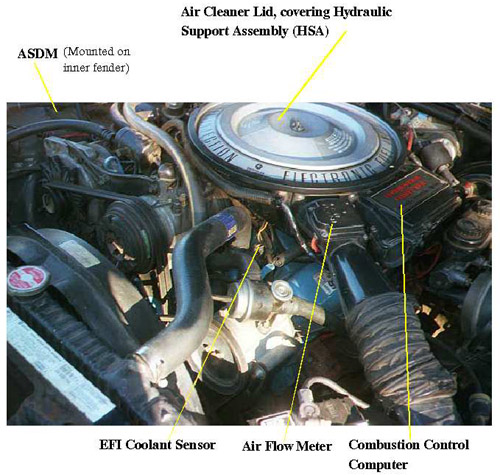
References and Test Reports: "Imperial’s Posh LeBaron" (road test), Motor Trend, July, 1965 "Motor Trend World Automotive Yearbook, 1966" "Chrysler: From the Airflow", Automobile Quarterly, Vol. VII, No. 2 (1968) 1967 to 1968 Imperials 1967 and 1968 saw the use of unit bodies and a further conservative, but elegant style. Both weight and size were reduced from prior models. 1968 was the last year for a convertible Imperial. 1969 to 1973 Imperials In 1969 the "fuselage" style was adopted, with little change until 1974-75, when a "waterfall" grill replaced the previous, very subdued styling. In 1971, the Imperial started to lose some distinctiveness and was sometimes identified as the "Chrysler Imperial" again. However, it spite of sporadic Chrysler badging on some '71's, there is a strong evidence that the Imperial was much more distinct from other Chrysler models such as the New Yorker or Newport. As one owner observed about his '73 with original paint and emblems, the word "Chrysler" is not found anywhere on the exterior of the car. Similarly, "Chrysler" emblems are not found on the '74 or '75's. Imperials still had their own separate VIN numbering system until '75, just like Chrysler, Plymouth, and Dodge. (Dan Dale) According to the IML Facts and Figures page, the '69 Crown Coupe production number was 244 - a rare bird. There were 4,572 LeBaron coupes built. 1974 to 1975 Imperials 1975 was the last year of the traditional, large Imperial and June 12, 1975 was the last day of production. 1981 to 1983 Imperials Lee Iacocca wanted Chrysler to have an elegant personal car, like the Eldorado and Continental Mark models. The Imperial name reappeared between 1981-83 on a such a car, using a smaller Chrysler platform ("J" Body) and the "small block" 318 cu. in. V-8. Unique to this Imperial is electro-mechanical fuel injection and an instrument display also controlled by computer. These Imperials were built in Windsor, Ontario. Sales of these Imperials did not meet corporate targets. Dick Benjamin writes: "These are rear wheel drive cars with 318 V8's. They are heavy and very luxurious. Special Interest Autos has a decent article in the January-February 1999 issue. They are often mistaken for much newer cars. I met a man at the local gas station who was driving a K-car Imperial from 1992, he thought mine was a newer model than his! The 81'-83's are closely related to the Cordoba and Mirada, sharing much of the body structure, but with unique sheet metal and engine management systems. The original EFI system is controversial. Those who have good ones love them, those who are burdened with troublesome ones are usually amazed how good they are when they are straightened out. Many owners took their dealer's advice and had the car converted to conventional carbureted fuel system, and that does provide a car which drives much like any other early 80's MOPAR Rear wheel drive car, and is easily repaired by any MOPAR mechanic. The original EFI system provides better drivability, better performance, and MUCH better economy, but is difficult to repair if you don't have access to a pretty special mechanic, or the Imperial Mailing List. Try one, you'll be impressed!" Dick Benjamin also supplied the following photo and system outline: 1981-83 Fuel Injection System
Electronic Fuel Injection System Components Indicated above are the locations of 5 items which are important to the operation of the EFI system.
1990 to 1993 Imperials The Imperial name disappeared until 1990-93, when a stretched Chrysler K-body became the Imperial. The engines were 3.3 and 3.8 liter V-6's, which also powered the New Yorker and many mini-vans. This was the only production Imperial ever built with front wheel drive. Length (in.) 203 What is the Black Beauty? The "Black Beauty" is the car driven by the crime-fighting, fictional characters, the Green Hornet and Kato. The 1966 TV show featured Bruce Lee as Kato. Also on this TV production, the Black Beauty was was a 1966 Imperial customized by Dean Jeffries. The Black Beauty was first restored by Mr. J. R. Goodman. The story of his restoration was on these web pages devoted to the Green Hornet and Black Beauty memorabilia, but cannot be now located. The Black Beauty is currently owned by Louis Ringe at L.N.R. Farms. Mr. Ringe has continued restoring the "special features" of the Black Beauty and has showed the car several times in California in 1999. The editor writes: "At the Spring Fling on April 15, 2000, Louis
Ringe had a very nice display showing the "Black Beauty". As most
know, this is a 1966 Imperial, customized by Dean Jeffries for the "Green
Hornet" TV series. When I was at the display, Louis was talking to a guy who worked on the
"Green Hornet" series and knew the car's history very well. I
neglected to get his name, but for the history buffs: What is the 1952/1956 Parade Phaeton? Paul Heinzman, editor of the "Imperial Eagle", published an article on this series of three cars, the "Imperial Parade Phaeton". What do the different MOPAR and Imperial body codes mean? The Chrysler Corporation Production Option Code Book published by Galen Govier shows the following for 1972-1975's:
Even though the Chrysler, Polara, Monaco, Fury and the Imperial all used the body code of C, the Imperial car line was a given the "Y" designation, the first digit indicating it was a separate line in the scheme of things. Notice the "Y" body Imperial is called a LeBaron - nowhere does it indicate Chrysler. (Joe Crossen) Paul Elosge further explains: "To simplify, let's just consider 1960-1978. And we'll
use the terms C and D body for the whole period, even though Chrysler didn't. (For a complete list of MOPAR body types from the '50's through the '90's, please go to the list developed by the MOPAR Mailing List). What do the different model names mean? LeBaron The LeBaron was the top-line production Imperial from 1957 until its demise in 1975. There were no unique roof lines and little exterior trim enhancements for LeBarons from 1957-59. In 1960, that changed with introduction of a limousine-style roof line. Broad wraparound C-pillars and a small rear window gave an elegant appearance and enhanced privacy for the rear passengers. (It did little for driver vision to the rear, however.) This small rear window remained a distinguishing exterior feature for LeBarons through 1975. The primary difference for all LeBarons was to be found in the interior. Here Chrysler lavished its flagship model with the most expensive materials and the finest of trim details. The "LeBaron" model designation/trademark was acquired by Chrysler when they purchased the Briggs Manufacturing Company in 1953. Briggs, in turn, had bought LeBaron in 1928. The original LeBaron Carrossiers was started in 1920 in New York by Tom Hibbard and Ray Dietrich, offering custom body designs only. In 1924 they acquired a manufacturing facility in Bridgeport CT and became a highly respected constructor of original bodies for the best American and European chassis - Lincoln, Chrysler Imperial, Duesenberg, Packard, Isotta-Fraschini, Rolls-Royce, Mercedes. The LeBaron name is recognized worldwide for their early designs and special bodies. Two of the most interesting designs of the "modern" era are the 1940 LeBaron Thunderbolt, designed by Alec Tremulis and the 1940 Chrysler Newport, designed by Tremulis and Ralph Roberts. The Newport was built on a 145.5" Imperial chassis. Several sources reported that six of each model were built. Reference: "LeBaron: Thoroughbred of Custom Coachbuilders", Automobile Quarterly, Vol. XII, No. 3 (1974) Crown The term "Crown" can mean two entirely different types of Imperials. Most commonly, the Crown was a model designation, like "LeBaron" and "Custom". When there was a LeBaron model, the Crown is the less-expensive Imperial below it. In years where there was a "base model" Custom, the Crown would be a middle model, between the Custom and the LeBaron. "Crown" less frequently designates the Imperial limousine. In such cases, the only correct terminology for such cars is "Crown Imperial". Other questions in this FAQ describe the Crown Imperial limousines. Southampton The "Southampton" was the designation for Imperial hardtops, both two-door and four-door, in the Crown and LeBaron series, between 1956 and 1963. For example, an Imperial could be fully described as a "1956 Imperial LeBaron Southampton Four-Door". Brougham "THE RETURN OF THE BROUGHAM" Hermann C. Brunn Automobile Quarterly, Volume 2, No. 4 (1963) "Originated for convenience, perpetuated for luxury is a capsule history of the Brougham. In 1838 the problem was how to be fashionable yet comfortable, for Lord Brougham, a bon vivant of London society, had wearied of alighting from a spacious coach for his daily social calls. At his request, Barker & Co. designed a close-coupled carriage with the two-passenger seat just inside a door hinged at the rear so his Lordship could step directly from the seat to the street. Unlike the "drawing room on wheels" type of coach requiring two horses to pull and three servants to drive and attend, the new design was a single-horse, single-coachman carriage with squarish boxy lines and solid quarter panel immediately beside the passenger for privacy. The "Brougham," so christened by Barker & Co., was soon in demand by a London aristocracy whose frequent clandestine calls are now a part of social history." "The features of the Brougham carriage - compact dimensions, a seat for two persons and a blind quarter panel - could be adapted to a motor chassis with little modification. Brewster & Co., of New York, the first in America to so adapt the Brougham, followed the original design carefully, advertising their 1917 automobile as "taking the place of the old horse-drawn Brougham." But a car costing $8,300 with seats for just two wasn't appealing to even those who could afford it, and the demand for greater capacity forced Brewster and most other coachmakers, including Brunn & Co., of Buffalo, to build larger bodies. The smartness of the vehicle remained, but its close-coupled convenience, the Brougham's main feature, was lost. These larger cars became known as Town Broughams or Town Cars - the latter being the translation of Coupe de Ville, the name given the Brougham carriage by mid-Nineteenth Century Parisian coachmakers. But whether Town Car or Brougham, whether seating for two or for seven, the chauffeur rode outside in these motorcars, a vestige of the day when a coachman was considered a servant unworthy of riding inside with the owner. In the democratic Twentieth Century, the driver was in the open for the sake of style. Style did take precedence over comfort in the early models, for the chauffeur's only inclement-weather protection was a lightweight leather cover, but in the mid-Twenties one of the Brunn engineers perfected a foldaway canopy that became widely used. These luxurious cars had passed their peak of popularity by the Thirties. After the end of World War II they were not revived. It is hard to believe today that one time Brunn & Co. built and delivered twenty Lincoln Town Broughams a month. Hard to believe and sad, too. For with the passing of the Brougham Town Car also passed a glamour, an elegance that symbolized the ultimate in affluence and taste." Also: What is a Brougham? (Jeff Stork) Back before there were Imperials, wealthy people were transported about in a closed horse drawn carriage known as a coaching brougham. Therefore, when the Cadillac people needed a littler extra panache for their Sedan De Ville de excess, they thought it would be better to call it a Brougham than a Buckboard. Frank Sinatra Edition Simo Harkila sent some information about the FS model, from the book "Complete History of Chrysler Corporation 1924 - 1985" by the Editors of Consumer Guide:
He also quoted picture text taken from the original '82 Imperial sales brochure:
Optional Equipment for '82 Imperial:
Ed Ferrara writes: "There was a special brochure that went with the FS Imperials. I have owned one since the cars were new, hoping to someday get one. It is the size and shape of a record album and has Frank on the cover with the Imperial in the lower right. Inside is a large picture of the car, and shows the tapes, carrying bag, and other features. It also lists by name all the tapes that come with the car. Anyone have any tapes, carrying case, crystal key and fob, or umbrella? Actually found the leather writing portfolio from a literature dealer." Click to go to Appendix A for the list of tapes! What engines did the Imperial use? From 1926 through 1936 the Imperial had its own engine. The 1926 through 1930 used an inline L-head 6 displacing 288 (26-27) and 310 (28-30) cubic inches. Power output reached 112 hp with the 310 engine. This engine was different from the rest of the Chrysler sixes with a bore of 3.5" (288) and 3 9/16" on the 310 engine. Both engines had a 5 inch stroke and had 7 main bearings. The Imperial six became the base for the Imperial 8 which was introduced in 1931. They basically tacked on a couple of cylinders, two more main bearings and reduced the bore to 3.5" to come up with the 384.5 cu. in. engine. This engine was used in all Imperials through 1932 and in the Custom Imperials 1933 through 1936. As the Depression marched on, Chrysler looked for ways to economize, and since the 384.5 engine shared no common components with the other engines, it was dropped at the end of 1936 and replaced with the 323 cu. in. engine used through 1950. The 323 engine had its beginning in 1934 in the standard Imperial. It was entirely different from the 384.5 engine. It had a bore of 3.25" and a stroke of 4 7/8". It was a much lighter engine and had 5 main bearings instead of the 9 that the 384.5 used. I have driven cars having the 384.5 and 323 and the 384.5 engine is substantially more powerful. Because of the long stroke and ample torque, it did a marvelous job of moving these behemoths down the road. I could never understand why Chrysler didn't keep this engine for the Imperial. If you have ever driven a '48 Crown Imperial, you would clearly understand the meaning of underpowered. Even with the lower axle ratio, these cars were lumbering giants and took in excess of 23 seconds to approach 60 miles per hour. Packard, Lincoln, Cadillac and Buick all had engines with substantially more horsepower. From 1938 on, the Chrysler New Yorker and the Imperial became closer with respect to power train configurations. By 1940, the New Yorker and Imperial had the same power plants. This practice continued up through the 60's. The Imperial really lost its mark as a prestige car in 1934 with the introduction of the Airflow. When Packard, Lincoln and Cadillac continued to build beautiful formal cars using 12 and 16 cylinder engines during the 1930's, Chrysler continued to downsize the Imperial so that it was virtually identical to the New Yorker. Consider the '46 through '48 Imperials - except from the longer wheelbase, they are essentially a New Yorker. 1957 really marked the start of a truly separate marquee, at least from a sheet metal standpoint. They regained their prestige and were among the finest, most luxurious and powerful cars on the road. (Gary Gordon) According to two tables of engine statistics on the MOPAR Mailing List, Dave Christensen and other sources, the following engines were used on Imperials from the '20's through the '50's:
Imperial used a 331.5 cu. in. V-8 hemi in 1955. In 1956, the size was enlarged to 354 cu. in. , and the horsepower rating was 250. In 1957, the hemi became 392 cubic inches and 325 hp. In 1959 the hemi was replaced by the 413 cu. in. "wedge" engine (RB block), which would continue until 1966 when it grew to 440 cu. in. Imperial horsepower was 350 in 1959, 340 from 1960-65, 350 from '66 on. What are the Imperial limousines? In 1957, Chrysler Corporation was faced with a decision regarding the fate of the Crown Imperial, its long-wheelbase limousine. Until that time the limousines had been built alongside regular Imperials. It was economically feasible to do so because this same chassis and many of the same body parts were shared with long wheelbase versions of Desoto and Chrysler. The radical redesign of the entire 1957 Chrysler Corporation line-up left no room for an in-house limousine program. A special chassis and special body would have had to have been developed and built, and the enormous costs could not be justified. Therefore, Chrysler set up an arrangement with Ghia, the Turin, Italy based coachbuilder that had produced so many of the Chrysler concept cars through the early ‘50’s. From 1957 through 1965, Ghia was responsible for the production of Crown Imperial limousines, all built to Chrysler’s design and specifications. Chrysler would ship specially prepared Imperials to Italy where Ghia would lengthen the chassis and create an entirely new body from the windshield to the trunk lid. Once bodywork was completed, a lavish custom interior was installed and the car was shipped back to Chrysler for final inspection and sale. Despite the tremendous cost savings Chrysler realized with this arrangement, these limousines were nonetheless the most expensive American cars made during that period. A price tag at the Rolls-Royce level kept total production quite limited. From 1957 to 1965 a mere 132 Crown Imperial Limousines by Ghia were built. For more information on these extraordinary cars, go to the following links: Appendix B - "Everything I know about early Ghia Limos", by Jim Crabtree Appendix C - "The Crown Imperial Limousines by Ghia", by Chris Hawkins Where were Imperials made? What is a 19__ Imperial worth? Which Imperial should I buy? Where can I find parts for an Imperial? Check the parts vendor listing on another web page: Who can fix an Imperial? I've had nothing but good work at Restorations by Julius, a shop specializing in MOPARs. Julius Steuer can be reached also at 818-882-2825 and is located at 10101 1/2 Canoga Avenue, Chatsworth, CA 91311. He's also very close to an Amtrak station, so don't hesitate to bring your Imperial from Virginia and take the train home! (Bob Schmitt) Also from another Imperial owner in Los Angeles:
Can I maintain my Imperial myself? How much does an Imperial restoration cost? Jim Crabtree This is for the web site as an FAQ Feel free to add or correct anything. We want the visitors to our site to be realistically and honestly informed. We assume that you are asking to get a business sense for car restoration. This is a good thing to do before beginning any project. DON'T TAKE YOUR CAR APART BEFORE YOU CAN AFFORD TO PUT IT TOGETHER AGAIN. General guideline: You have an OLD car, to make it NEW again will cost at least as much as buying a NEW car. There are many ways to restore a car. Let's start with the most expensive way first, a professional restoration shop. These are places where you can drop your car off, leave a healthy deposit (and be prepared to send monthly checks) then come back 1½ to 2 years later and have a NEW perfect car. The cost? Plan on spending $30,000 minimum, up to $60,000 or more. This is for routine production type cars like those made in the 50s up to the 70s. Most folks do not have this kind of money so they do the restoration themselves. Effectively they act as the "general contractor" and get "sub contractors" to do the actual work. A "drive-around restoration" it is sometimes called. (driving from the paint shop to the upholstery shop etc.) Cars are repaired in 3 general areas; exterior, interior and mechanicals. Assuming there are no major problems with your car in the first place (the reason people buy the best condition car they can get) plan on the following: Mechanicals is where most people start Motor $2000+. You will need to fix all the accessories too. Water pump, radiator, generator, motor mounts etc. Transmission $1000. There is only one way to fix an automatic, a complete rebuild including U- joints & any necessary drive shaft work. Rear axle $0. Rear axles usually last several lifetimes and rarely need rebuilding. If yours does need repair, replace it with a used one from another car for about $100. Brakes $250. Don't trust your life with anything less than all new wheel cylinders, hoses, master cylinder etc. Suspension $400. The rear is usually OK but the rubber bushings and the wear parts in the front go bad (tie rods, center links etc). Some replacement items are very scarce and will be priced accordingly. Tires will be about $450 - assume about $100 each for a good wide white wall type of tire. Accessories $300 and UP. Air conditioning/heater, cruise controls, radios, automatic headlight dimmers, power windows & vents. Imperials generally had lots of "toys" and some can be quite involved to repair. Exterior, to make it look nice Body & paint $2000 and UP. Body repairs such as major collision damage and rust can run up a very big bill very fast. $2k will cover a basic re-spray on a car with small parking lot type damage. Time is money and good body work takes time. The paint alone (with necessary associated chemicals) runs in the neighborhood of $100 per gallon. Most cars take at least 2 gallons. This is why collectors value good straight rust free bodies above all else. Chrome $1000 and UP. Used to be chrome plating was very cheap. Then the EPA and other regulatory agencies stepped in and now chrome shops have to pay exorbitantly to have their wastes treated and hauled to special landfills. These costs are passed on to you. Imperial bumpers are HUGE. Plan on $150-$200 minimum per bumper. (BTW, shops charge extra for each bumper guard and other attached pieces.) As you add up all the little pieces of trim the final tally can be quite high. Glass $200 for windshields, $75 each piece for flat side glass. Curved side glass usually must be purchased used. Rubber gaskets for the windshield are in the $100 range (when available). Interior, where you spend most of your time Seats $1000 and UP. Seats can be 'covered' very cheaply by upholstery shops using generic fabrics and vinyls and if you don't need any sewn pleats or patterns $100 will make your seats 'sit-able'. BUT when you want it done right, this costs more. Original fabric does exist, plan on $100-$200 per yard most cars taking 3-4 yards. Leather? $250 per hide you'll use 2-3 hides. Carpets $200. There are pre-made kits that can be installed yourself or an upholstery shop can usually sew up a very nice looking carpet. Headliner $200. Some headliners were originally cardboard or fabric glued to cardboard. These are something that would have to come from the reproduction suppliers. If this is the case, the price will be similar, but availability will be an issue. Door panels $100 each and UP. Imperials often used very interesting construction techniques and reproducing/restoring these can be very expensive (if it can be done at all). Early 50s flat types consisting of pure fabric are easy. The molded plastics with internal glove boxes from the later years are much more difficult. If yours are really shot, it is best to get a set from another car. In many cases they can be dyed or painted to match. Padded dash $300+. These have to specially molded and cannot be created with any authentic appearance by an upholstery shop. The dash is a focal point of the interior. If your dash is sagged or torn or cracked and an exact replacement is available, bite the bullet and buy a new one, you will be happiest in the long run. Well there you have it. The moral is to restore the car to a level that you are happy with. Fix what YOU feel it needs. Most projects are done on a time and money available basis. DO NOT EVER ASSUME YOU WILL RESTORE YOUR CAR AND SELL IT FOR A PROFIT!!! Don't even think that you will get your costs back. Restore your car for the fun and love of it. Joseph Crossen adds: "Restoration comes at several levels, you can restore a car to the point where it is a "trailer queen" or something that you feel can be driven now and then. Many folks have asked me what it costs to restore a collectable car. My answer is always....you buy a car for $2,000 and stick $10,000 into it or you buy the finished car for $12,000. This doesn't answer you question totally, this is my experience with collectable car restorations. Bottom line is that you will spend much more to restore your beauty to your satisfaction than it is worth, but who cares, it's what we want to do. Again, there is a fine line between restoration overkill and taking the joy factor out of owning and driving a car. One guy I know spent $11,000 to restore his pristine '64 Impala convertible and now he doesn't drive it anymore because the humidity may damage the car. Guess I haven't really answered your question about costs....it's a long process of loving the breed and chasing after the parts over the years. It's the gist of the hobby. It's what makes the whole thing fun." Why did Chrysler stop making Imperials? Is it true that Imperials were banned from destruction derbies? In a Wall Street Journal article titled "Demolition Derby, A Lawless Sport, Gets Some Rules", Daniel Pearl writes in part:
The article doesn't have a date on it, but a nearby article noting of the death of Harriet Nelson means it's October 3-5, 1994 or so. Perhaps someone can check back issues - it was a front page article. How do I find out more about Imperials? Join one of the traditional Imperial clubs or the Internet-based Imperial Club and Imperial Mailing List. Join your local WPC Club. Go to the list of references (above) and start reading at the top and continue down the list! Which Imperials did Virgil Exner style? Virgil Exner started with Chrysler in 1951, but by then the designs for several years had been finalized. Some say that he had some influence in the 1954 trim, but that clearly the 1955 was the first production design for which he bears responsibility. The last would clearly be the 1962, although Exner did not like it and would not take responsibility, as he did not approve of the truncated fins. As far as the first Exner-designed Imperial, however, it would have to be the 1952 Imperial Parade Phaeton, of which three were built in 1952. One each was presented to New York, Los Angeles, and Detroit for official use. These cars used 1952 front sheet metal, but otherwise were totally custom dual cowl phaetons. They were also updated in 1955, with full Exner 1956 Imperial styling. Which Imperials did Elwood Engel style? Elwood Engel, a long-term stylist at Ford’s Art and Color, is credited with the classic styling on the 1961 Lincoln Continental. At Chrysler, his design team was responsible for the ‘64-’66 Imperials and models through the "fuselage" era. Chris Hoffman wrote: Engel was still in charge of design for the fuselage cars, so you can credit Engel for the design of Imperials and C-bodies all the way up through 1973. 1969 and later Imperials use the same body as the C-bodies (and the '67-68s use pretty much the same body, except for sheet metal), but all these Imperials were considered Y-bodies. Many C-body components interchange; lots of others do not! (They were built to a higher standard.) Engel's design chief, Richard Macadam, took over when Engel left Chrysler for treatment of prostate cancer in 1974. Since the 1974 models were designed well before 1974, they, too were probably Engel’s. It's remarkable how different his later work at Chrysler (especially the fuselage era) was from his early work (and his work at Ford). Perhaps the breadth of his designs are one reason he's not as well recognized... he didn't have a single signature like so many others. Mark McDonald then replied: I wouldn't bet the farm on this, but I do think he had a couple of signatures, and I have heard that one criticism of the '64-'68 Imperials was that they were too "Lincolnesque" - in other words, similar to the 1960-up Lincoln, which he also designed before he left Ford. I think you can see enough similarities between these 2 cars to say they both bear his signature. Just a few things I have noticed, and again I'm not an expert: 1. The use of a long, straight "through line" when the car is viewed in profile. There is nothing to break up the fender line from front to back, just one long straight, smooth line. I believe Exner was always trying to break up his designs, front to back - the rear is higher than the front, the doorline is dropped, etc. 2. A lack of adornment (mainly chrome) and a reliance on shape and volume to make the statement. 3. A forward leaning look. His cars tend to look as if they're leaning forward into the wind - as if in motion while standing still. This is the opposite of most GM products of the day, which were sloped back, looking as if they were reclining. 4. A long trunk, short hood sense of proportion. The trunk of my '71 looks much longer than the hood. This, again, is the opposite of most other products of his day, which were following the Italian race car proportions popularized by the Ford Mustang - short rear deck, long hood. 5. Downturned angles. I don't know what the hell this means. I just mean, the angles on his cars tend to draw your eye down toward the ground - they're not swept up. Example: if GM had designed the '67-'68 Imperial, the bumperettes on the back would be turned upside down. They would be leaning back toward the rear of the car, like fins. Anybody follow that? These are a few things I've noticed about his designs. I'd love it if anybody else sees any more "signatures." Of course, he probably wasn't the only guy to do these things, but I think he was one of the biggest. Mark Brauer also wrote on this point: I contend that Engel DID have a signature; the knife-edge fender line, alluded to by Mark M. here, wherein the outside edges of the fenders stick up rather high, higher than hood, in some cases! Most prominent on his Lincoln and '64-'66 Imperial, but it still showed up on the Fuselage cars, and, as my memory serves, even the '76 Plymouth Gran Fury Sport Suburban wagon we had growing up had this feature, though not highlighted by a strip of chrome as on many of his other designs. (Remember the '66-'67 Charger!) Chris H replied: While Engel's knife-edge fenders are his strongest signature, they pretty much disappeared on the fuselage cars, including the midsize Mopars of the 71-74 era. To the outsider, they do not appear to be of the same design school. This was my point. Engel's versatility (compare a '63 Dart to an early-70s Fury or a '72 Dodge "Lifestyle" pickup) may have clouded the signature for which he might have been more clearly remembered, whereas someone like J Mays or Exner manage/d to make most of their cars more clearly born from a singular aesthetic philosophy (note the New Beetle-esque headlamps and taillamps on the '02 Thunderbird). The almost neoclassic '74-78 fullsize Mopars represented something of a return to the trademark Engel shape (even though the '74-75 Dodge models had heavy hints of the 1971-2 Chevrolet), and parking my '67 and '78 next to each other certainly suggests heritage. But toss a '73 in between and that lineage is rather clearly interrupted by the futuristic smoothness of the fuselage cars. In case it was not clear, Engel is probably my favorite auto designer (and I own four of his works!) of the modern era. Elijah wrote again: 1969 and later Imperials use the same body as the C-bodies (and the '67-68s use pretty much the same body, except for sheet metal), but all these Imperials were considered Y-bodies. Many C-body components interchange; lots of others do not! (They were built to a higher standard.) '69-'73 Imperials are VERY different from their Chrysler counterparts. :o) I hadn't realized just how different until a few years ago when I helped a friend part out a '71 New Yorker. About the only parts in common are the doors and the unibody portion of the car. ALL front end components and most other drive train and suspension components are unique to the Imperial. The Imperial drives and handles dramatically different than its cousin New Yorkers. On the interior, the quality of materials and workmanship for carpets, seat covers, door panels, etc. is also noticeably superior to other Chrysler models. While some minor components (such as the radio and speakers) may be shared among the different makes, Imperial tends to use bigger/better/higher quality on almost everything. Just check out a shop manual sometime and notice all the areas in which specific instructions are given just for Imperials. In other words, there really IS a difference. Bruce Smith then also noted: There is a great book titled "A Century of Automotive Style: 100 Years of American Car Design". It is still being published and was written by Michael Lamm and the late Dave Holls. There's info about Engel's career at both Ford and Chrysler, as well as much about Virgil Exner. Engel officially retired from Chrysler in 1974 and was replaced by Richard Macadam, who had been appointed by Engel to head up design for standard-size cars starting in 1970. Macadam first came to Chrysler during the Exner era. Clearly, the wonderful looking fuselage designs were done under Engel's direction , and no doubt the 1974 and 1975 Imperials. We can also assume that Macadam had a big influence over these cars. The world and history of automotive design...which is what I think of as styling...is fascinating, and I've never come across a book as thorough as this one. It's well worth the slightly high price of $60. Did Imperial have any show cars? I can recall two factory Imperial show cars, at least. In 1958, the Imperial d'Elegance toured the auto shows. It was a non-functional futuristic four door hardtop which, amazingly, predicted the busy contours of the Valiant. Exner is said to have disliked it, perhaps because of the bizarre proportions. In 1965, another Imperial show car was constructed, called the Imperial LeBaron d'Or. It was simply a custom trimmed LeBaron painted laurel gold, with gold striping and trim. Much later, I visited the Detroit Auto Show in 1983 and saw an Imperial stretch limousine, quite handsome, painted deep blue with matching interior. (Jeff Stork) In 1966, there was a Mobile Director show car. See the article written by Chris Hawkins on the IML web page. Which Imperials are Classics? Jim Crabtree People who own old cars regularly refer to them as "classics" but are they really? There is a club for 1955 to 1957 Thunderbirds called the Classic Thunderbird Club International (CTCI). There are books written about the "classic" Chevrolets of 55 to 57. Long before these cars were in the blueprint stage, collectors had begun to attempt to describe and define exactly what a Classic is. Begun in 1953 the Classic Car Club of America (CCCA) was formed to celebrate the distinctive luxury cars made during the thirties. Duesenberg and Sixteen cylinder Cadillac's were always known to be special cars, but world war two had been hard the big cars made during the depression. Marketed during the toughest economic times the world had ever known, they were created as status symbols and playthings for the very select few people that still had a disposable income. Status comes under the heading of conspicuous consumption. Displaying your wealth by consuming resources faster and more flagrantly than other people. Resources like gasoline at 4 to 8 mile per gallon. Enormous tires of unique sizes the are not regularly stocked outside of the original selling dealer. Driver compartments that were designed sometimes for the distinct discomfort of the driver. (i.e. open front town cars). Wheelbases that would ensure that the vehicle could not be parallel parked and must be secured only in a large lot or parking structure. These were cars that had little PRACTICAL transportation value. By the start of WWII many of these vehicles were 10 years old and during times of rationing and conservation their value became judged mostly by their weight in precious metals instead of their condition. But they did run and drive during the years when no new vehicles were produced so they did sometimes see use despite the difficulties. After the war new cars were back in the showrooms so there was absolutely no need to maintain these beasts and their destruction seemed imminent. The only cars that were routinely collected after the war were the very early brass and horseless carriage vehicles. People who had lusted after the big cars of the thirties now saw them as obtainable. Their desire to congregate with people of similar interests led to the creation of the CCCA in 1953. Their first and ongoing task even today, was to define and identify exactly what a Classic is. (You will note the use of the capital "C" in Classic) Eventually the definition came down to describing distinctive, expensive, limited production cars. The age limits were eventually set between 1925 to 1948. The CCCA has jealously guarded their "Classic" word and dislikes having it applied to vehicles outside of their purveyance. They especially dislike the concept of the 50s classics noted above. Recently the CCCA has even taken steps to trademark the terms "Full Classic" to describe the vehicles of their passion. Interestingly, in CCCA publications whenever a non-Classic is mentioned it is identified with a (nc) after the listing. Example: "He also owned a 1932 Ford (nc) during that time". Is there a list of Classics? Yes they publish one regularly and update it as new Classics are occasionally added. This brings us to the point of this FAQ "Which Imperials are Classics?" According to the CCCA, the following Chryslers, Imperials and Chrysler Imperials are Full Classics:
Newport As far as I know there are only four Newports around but I don't know where they are. I remember someone years ago telling me that Sonia Henie, the skater and film star, had one but wrecked it. I sold mine about 6 years ago to a fellow in Connecticut. There is a question as to how many were really made - 4, 5 or 6. Years ago in a letter from Chrysler Corp. they said that there were only four Newports and six Thunderbolts. Usually articles say there were six of each. Since the two cars were usually displayed in 1941 in pairs, I would assume that the same number of both were made. From various photos I have seen over the years, I have been able to identify four Newports due to slight differences. As for the actual pace car, it was either
the one in the museum or the one that I had. If I had a good picture taken at
the race track the day of the race, I could tell which it was. The only pictures
I have seen were newspaper quality. I have a photo that Chrysler sent me from
their files that showed the one that I owned with the pace car lettering on it,
however, they may have painted that on all of them for publicity purposes. (Dave
Caldwell) Louis Ringe wrote: If a black car has a lapse in registration it will be fitted with NEW plates (at least in Ca.) I found this out when I went to register the Black Beauty which hasn't been done since 1982 and they put new plates on it. And Chris Hoffman wrote: If the original plates are still with the car and you have an old registration to prove they belong to the car, the California DMV, with some prodding (not easy but possible... helps to have a good DMV runner), will let you reattach them. But once the plates are gone and the paperwork, too, you cannot just substitute similar-series plates after 1962 (this is the YOM program). My 1967 Crown got vanity plates in the 1970s but I've gotten it back to its original black plates legally (thankfully the first owners kept most of the car's paperwork), and do they look nice! Mike Sealey then reported: I just went through this with my '66 Cadillac, which had not been registered since 1985, and thought I'd pass on my experiences. I had to jump through some hoops with California DMV, and hopefully my experience will be of help to someone else. I didn't have any registration cards, but the pink slip did show the plate number. Apparently the big question is matching plate number and VIN on an original California DMV document, whatever that document is. I would also guess they would not accept anything handwritten as official documentation. I also had to go through VIN verification, just like when you bring in an out-of-state car. No problems there, but I'd suggest that anyone doing this know ahead of time where the VIN plate is on their car, especially if it's not visible through the windshield as it is on newer cars. My DMV examiner knew where the Fleetwood's VIN was, but some may not, especially the "MOPAR-phobic" (these people need to get over this). The first DMV examiner I spoke to had never done this before and had to ask some senior field reps what to do. At least one of these was pretty adamant in her insistence that I had to give up my black plates; fortunately, I had a friend who had just gone through this on a Studebaker Hawk, and had given me "some" information on what he went through to save his. I was also fortunate in that two other senior reps seemed to think there would be no problem. What finally happened was I was issued a "suspense receipt" (one of those red window stickers with the white number; apologies to non-Californians for this minutiae) and my application was sent to DMV's Special Plate Unit (SPU) in Sacramento for approval. I was issued a temporary registration, which assigned my car a weird number (Q followed by seven numbers) in lieu of a plate number, and which contained the notation "Reason For Suspense: Wants To Keep Blackgold Plates". About a month after that, I received a registration in the mail from Sacramento, showing the number of my black plates and including the appropriate tags (my registration now expires in April, so they sent me an "APR" tag with my '00 tag). Interestingly enough, my pink slip arrived in the mail the next day. I hope this helps anyone else who wants to save their black plates. I also hope this story will be useful for inclusion in the FAQ section.
FRANK SINATRA TAPES INCLUDED WITH THE 1982 IMPERIAL - FS "SINATRA'S SINATRA", Code M5 - 1010 Side 1
Side 2
"ACADEMY AWARD WINNERS", Code M5 - 1011 Side 1
Side 2
"IT MIGHT AS WELL BE SWING", Code M5 - 1012 Side 1
Side 2
"SOFTLY AS I LEAVE YOU", Code M5 - 1013 Side 1
Side 2
"STRANGERS IN THE NIGHT", Code M5 - 1017 Side 1
Side 2
"THAT'S LIFE", Code M5 - 1020 Side 1
Side 2
"THE WORLD WE KNEW", Code M5 - 1022 Side 1
Side 2
"CYCLES", Code M5 - 1027 Side 1
Side 2
"A MAN ALONE", Code M5 - 1030 Side 1
Side 2
"TRILOGY: THE PAST (COLLECTIBLES OF THE EARLY YEARS)", Code 3F5 - 2300 Side 1
Side 2
"TRILOGY: THE PRESENT (SOME VERY GOOD YEARS)", Code 3F5 - 2300 Side 1
Side 2
"TRILOGY: THE FUTURE (REFLECTIONS OF THE FUTURE IN THREE TENSES)", Code 3F5 - 2300 Side 1
Side 2
"SEPTEMBER OF MY YEARS"
"MY WAY" - 1029
"SINATRA'S GREATEST HITS, VOLUME I"
"MY KIND OF BROADWAY"
Additional cassette tape, perhaps included with all Chryslers equipped with tape decks: "SOUND OF STEREO" - THE NEW CHRYSLER CORPORATION, Code DAK1 - 0451 Side 1
Side 2
Everything I know about early Ghia Limos Jim Crabtree Chrysler seemed to really like long wheelbase sedans. They made more of them than anybody else after the war. The many long wheelbase Dodges & DeSotos were not really limousines. More correctly they were 8 passenger sedans. The long wheelbase allowed room for the folding jump seats that increased the passenger capacity. I do not think that any of these came with divider windows. They were "taxis" and Chrysler filled a niche with them. Chrysler did offer a real "limo" (by the common meaning of the word) in their top line Chrysler & Imperial lines for each year 1949 to 1956. The production of these special vehicles was about 150 to 200 cars each year counting both the divided and non divided versions. There is absolutely no profit for an auto maker producing cars in these small numbers. The inclusion of a top line luxury car does lend a lot of prestige to the marquee, and when it is used by famous people, images of your car appear in the newsreels and gather other "free" publicity. The dollar loss per car can be balanced out as advertising costs. Chrysler was probably able to continuing making their limos because times were good and their body structures were consistent enough that the production tooling costs could be amortized over several years of output rather than just one. Then came the 1957 cars. Radically different, their tooling set Chrysler back a significant sum. The Imperials before 1957 were far from volume sellers (Chrysler had no idea how good the 1957 model year would be for Imperial) and there was no way that the bean counters would let money be spent to build a car that had seen only 398 copies the previous two years. (172 in 1955 and 226 in 1956) But the publicity/marketing people wanted a limo in the 57 Imperial lineup. For many years Chrysler had been having Ghia coachworks in Italy build their one off show cars. Hand labor was cheap in Italy after the war and the show cars seemed to come in on time and on budget. Since Ghia had proven themselves able to build a low number of very different cars, then building many copies of the same type of car should be a snap. Chrysler knew that even in this small run, costs had to be recovered and that would further restrict sales. They planned to build only 75 during the first model year 1957. Figuring that this was about half the production of each of the previous two years this output should be realistically achievable in sales. And heck, any automaker should be able to sell at least 75 copies of ANY car that they produced. Plans were drawn up and parts were shipped to Italy. If you are interested in the full Ghia limo story you must get copies of "Special Interest Autos" issues # 14 and #15. Originally published in January and March of 1973 they are readily available as reprints (see Hemming's Motor News) and frequently come up at swap meets $1 - $5 each. The "kit" cars that were shipped to Italy, were TWO door hardtops sitting on convertible frames. They had no doors or interiors. They were shipped loaded down with four door center pillars and door skins, seat frames, side glass, trim and even cans of paint. The cars were shipped to Italy with as many American made parts as possible. When the c ars arrived back in this country customs assessed them and taxed the value of what ever had been done in Italy. Chrysler wanted to pay for the value of the labor only. Hence the inclusion of so many US built parts including paint. It has never been said but I suspect that they sent extra sheet metal too. The car was priced at $12,000 initially. This may seem in line today, but a 1957 Cadillac limo cost only $8300 (even after you added the optional A/C, which was standard on the Imperial) In 1958 the Cad was up to $9300 (with air) but the Imperial now listed for $15,750. During these years you might think that there would be at least 75 people in the world with $12,000 to $15,000 to spend on a car but there obviously was not. Production of the Imperial Ghia limos is listed at:
The numbers seem unusual compared to Chrysler limo production for other years. Those "huge" drops in 59, 61 & 62 have a reasonable explanation. I assume when Chrysler announced that they expected to sell 75 cars in 1957, was that 75 units was their contracted production total with Ghia. Ghia was going to be paid for 75 cars whether they built them or not. The total for the three years 1957 to 1959 is 74! Three years to sell your first year's output. This I feel is illustrative of how difficult it was for Chrysler to actually sell these vehicles. It was not the cost alone that made it difficult to find homes for these cars. During 1957 - 1958 Cadillac sold 700 Eldorado Broughams ($13,000). In 56-57 Lincoln sold 3000 Mark IIs ($10,000). The problem was that most limos are NOT bought by wealthy people who employ chauffeurs. During the 50s most limos were being bought by funeral homes or auto liveries. A funeral home is a business like any other and their biggest consideration is the bottom line. You simply can not make a profit with a $15,000 car. It is a wonder they even continued the program into 1960. Looking at the 60 & 61 production my guess is that the second Ghia contract was for 20 cars (slightly less than the yearly production of 57 or 58). They licked their wounds in 62, then contracted for only 10 cars each year in the years 63 to 65. Each time they seemed to be cutting their previously contracted production number in half. Ghia, the cars Because the cars were built in Italy, shipping time had to be factored into the production schedule. The kit cars could not be shipped until production started in America. It took Ghia about 6 months to complete a car. This meant that it was virtually impossible have a limo on hand for announcement time. Chrysler tried to hide this by combining and intermixing trim from next year's production. Photos are rare for '57 limos (I have never seen one with single headlights). By the time the 57s were coming back from Europe, the 58s were almost in production or already coming off the line. Because of the difficulty calculating the value added import tax, I suspect that the 58 parts were added when the cars arrived back in New York. This really became an interesting situation when the last 58s needed to be updated to 59 styling. There is a beautiful 1959 Ghia pictured in Collectible Automobile (October 1994). It has the 59 grill and taillights but the interior and dash are all 58. As an interesting side note this makes the Ghia limos the only "1959" Chrysler corporation cars to still use the 392 Hemi. My own Ghia has a serial number of LY-1033. This translates to being the 33rd 1958 Imperial off the line. I would love to see a roster of Ghia serial numbers. (IML project?) I suspect that they will be sequential or very close. My car has several 57 parts on it. It has 57 "Fire Power" valve covers instead of the 58 "Imperial" versions. The inside rear view mirror is mounted at the base of the windshield instead of on the dashboard like a 58. These 57 parts are probably the result of it being a low numbered 58 rather than a Ghia limo (anybody else have a very early 58 Imperial?) Other things that are Ghia items. The plastic insert in the bird's belly on the hood says "Crown Imperial" with Crown in small block letters and Imperial in large script. I am totally not familiar with regular Imperials. What do other 57 - 58 Imperials say in this space? The generator is a very large, high amperage type similar to ones I have seen on 1956 limos. Right now my car has a flight sweep deck lid from a parts car. I did get the original deck lid with the car. Smooth type, but has a Ghia-only cast aluminum (pot metal?) bird at the bottom near the handle. It has no real detail and could have been cast in a high school metal shop. Mine is cracked but I don't see reproducing it as much of a problem. The trunk was FULLY carpeted including the underside of the lid. It seemed to use the same black nylon carpet as the front compartment. While I am talking about carpet, the many articles about the car talk a lot about the mouton carpeting in the rear. (BTW mouton is sheep skin. Very thick, very soft pile, like fur.) What you don't hear about is that the mouton is really a mat or throw rug. There is nylon carpet permanently affixed to the rear floor. Presumably the mouton would be rolled up & stored on rainy, muddy days. The front door panels are 100% real leather, including armrests. The cushion on the right side of the front seat flips forward to access a carpeted storage compartment. While I am talking about the front seat I should mention that the car cannot be comfortably driven by anyone over 5'5". I am 6' 7" and the distance from the seat back to the dashboard is exactly the length of my femur. When driving, my knees are jammed into the dash BETWEEN the various knobs. If you are thinking about getting one of these cars this is a major consideration. I love how it looks, but it is a physical pain to drive. The jump seats seem to be from the 55-56 limos. While jump seats are not suppose to be roomy or comfortable the only folks that have fit properly on mine are 6 & 7 year old kids. They are too high (no head room) and sit too far forward (can't get your knees past the trim panels). Ghia Values For $15,000 you would hope that the car would hold it's value. This does not seem to be the case. Compare the following values with Cadillac and Lincoln limos. These figures come from the "Red Book" published for the east coast. Strangely, it lists values for Ghias and Cadillac's but not for the Lincoln limos of 59 & 60. The west coast "Blue Book" lists the values for Cadillac and Lincoln but nothing for Imperial. Neither book lists a 1957 Ghia. Values given are for 1958 Cads & Imperials. Lincoln's limo did not come out until 1959. (Wholesale / Retail listed)
These published values may not have been established very fairly, with production as low as it was for the Imperial Ghia - I wonder where the publishers got their data from? (Notice the value of an Imperial Ghia between Oct 58 and Jan 59; it went UP $3000 in 3 months!) How many cars actually changed hands in any given year? Interestingly by 1962, Cad limos seem to be worth less on the West coast compared to the East coast. Maybe this is why the Ghias had values listed only in the East coast Red Book. Did they sell more of them there? What are they worth today? The 1996 Cars & Parts Price guide says (all values given for #3 condition):
So what is a Ghia limo worth today? This is one of those situations where the car is so rare and the person who is ready pay for one is even rarer that I believe that there is NO "market price". If you want one, find one for sale and ask yourself "Will I pay that much for this car?" My car is a #4 condition (but I did drive it home to LA from Canada) and I paid $12K. I turned down a mint one for $30K and could not get an idiot seller to accurately describe or show me his car when he was asking $15K. Ghia Literature A magazine article from 1957 describing the car includes a phrase that is so politically incorrect that it could not be used today to describe any car, but sums up both the car and the era. "A Ghia built Imperial limousine features craftsmanship from Italy, engineering from America and leather from the finest animals in the world." Just how much was Chrysler going to spend on producing literature for a car when they only expected to sell 75 copies? I have two brochures for the car. Neither one is dated, but one I call a 57 and another I call the 58. The 57 version has one large side view drawing of the car (no photos), and drawings of 5 differently styled interiors. Obviously these are the proposal drawings from the styling studio. The differences between them are more than just stitching and pleats. One shows a wrap around seat that is similar to the back seat of a 64 - 66 Thunderbird! Styling of the power window switches are so different as to require different bezels etc. They just did not seem know what they were going to actually build. I suspect that only 1 or 2 different interiors were actually offered, the differences being the stitching patterns. The "58" piece is all photos, no drawings. The pictured cars all seem to have 58 styling. Except for a chrome belt line molding that does not appear in other published photos. but appears on every car in this catalogue. The photos are taken at various ritzy places in Italy and New York but my favorite is the one that appears on the back cover. Here the car is photographed in front of what would later become the Beverly Hillbillies mansion! Long before that TV show was even conceived, there was a Chrysler connection. A caption for the interior photo identifies the only Ghia option:
A/C and front & rear radios were standard. The cars do not have headlight dimmers or auto pilot. The cars are listed as being available in black, deep blue, deep green or maroon paint colors. All with a black leather roof section. (real leather? I wonder - mine is gone) interior colors were beige or blue-gray. This is the only copy of the "58" catalogue I have ever seen. The 57 is in a mailing envelope. I have no idea how they were distributed. I can't imagine them being stacked in the racks in the showroom. Even if they were kept in somebody's desk drawer how many would each dealer have? On the last page, back cover it instructs the reader that if further information or prices are desired, they should write to the President of Chrysler Corp. (Wow, imagine getting the president/CEO to be your salesman). (BTW I paid $125 for the 57 version. I saw another one at the Iola swap meet for $175. The 58 was a gift from a friend. He got it as part of a large Chrysler collection, value unknown). If Chrysler produced a dealer album or color & upholstery book for the limos I would love to see one! I do have in my collection two different albums for the 1959 Lincoln limos. Lincoln limos were pictured and discussed in their regular catalogues for 1960. This is not true for the Imperial. But at approximately 150 units I guess the Lincoln qualifies as a "high production" car. Imperial did run at least one ad for the limo in the February 1958 issue of Town & Country magazine, page 115. This issue also has an ad for the Eldorado Brougham. I have been told that the Ghia limos came with their own "owners manual" describing the various features, it was 4-5 typewritten mimeographed pages! Does anyone have a copy? I know of no reference to the Ghia cars in the regular Imperial owners manual, shop manual or parts book. Does anyone know where the service information that was unique to the limo appeared? For the 59-60 Lincolns, there was a series of service bulletins that explained what did not appear elsewhere. Well that does it for me, if anyone has any questions or can add to this or provide corrections please do so. (Jim Crabtree ) Chris Hawkins added this article: The "kit cars" sent to Ghia were 2 door coupes for 1957-59 production. Beginning in 1960 through 1965, production was based on 4-door LeBaron "kit cars". Note: no seat frames were sent, because unique front and rear seating was custom built by Ghia. Instead, a wooden bench was installed for driving the car on and off the boat to the Ghia factory. (See photo in the January 1973 Special Interest Auto article.) The Crown Imperial
Limousines by Ghia The 1964 Crown Imperial Landau Limousine
by Ghia is one of the last of a line of extraordinary American luxury cars. The
Ghia limousines offered by Chrysler from 1957 to 1965 also represent the last
series of coachbuilt cars ever likely to be offered by a major American
manufacturer. They were the glorious last hurrah of a tradition of hand
craftsmanship that found its zenith in the '30's on the legendary classics of
the era. As befits the custom nature of these cars, don't be surprised when you see a
Ghia limousine that exhibits bits and pieces from previous or subsequent models
years. For instance, most '57 Ghias had '58 grills, 1959 Ghias still had Hemis,
1961 Ghias used 1960 bodies, and 1965 models still had pushbutton TorqueFlite.
This 1964 Ghia is no exception. As one of the first Ghias built in 1964, it is a
very early chassis and thus sports the rare white Imperial script in the
windshield garnish moldings. Plus, it has the spring-release door armrest pads.
Therefore, it is reasonable to assume it had a 1964 grill when delivered. In the
'30's it was not uncommon for owners of custom bodied luxury cars to modify and
update their cars periodically. For instance, a high percentage of Duesenberg
chassis are on their second or even third body. It is said that the original
owner of this '64 Ghia regularly had the grilles updated on his car, first in
1965 and then again in 1966. The result is an appealing amalgam of design
elements from different years, not unlike many other of its earlier brethren. Comment by Jeff Stork: I really enjoyed Chris Hawkins' piece on the Crown Imperial Ghia. I think
it's great to have one member share the experience of such a rare car so that we
might all have a glimpse of what it is like to drive one. I do recall that my
own Ghia drove almost exactly like a standard Imperial, which is high praise for
a limousine conversion. As far as some of the individual variances, it comes down to a matter of
small volume and the time needed to convert the car. All of the 1957 limousines
were said to be delivered with 1958 grilles because it took so long to get the
program running that the 1958 models were ready about the same time as the
limousines. Likewise, the 1959 models don't just have hemi engines - they are 1958 cars
with 1959 grilles. Look at the engine, dash, even front fender scripts - they're
really 58's. The 1961's were simply unsold 1960's. (And by the way, I have a wonderful ad
from Chrysler Manhattan announcing the arrival of the '61's in limited numbers.) A look into the product brochure for 1965 clearly shows the 1965 to be a
modified 1964 - the all-die-cast dash face with push button drive, the wheel
covers, the fender mounted LeBaron scripts (real 65's has sail panel script) -
it's all there. I personally do not believe that it lessens the car or the legend in any way.
It's just the reality of trying to build semi-customs half a world away, and
still accommodate annual styling changes. I do disagree, however, with the off-the-cuff dismissal of the Lehmann-Petersen
Continental. While the L-P car did not have the aura of being hand assembled in
Italy, it was nonetheless a finely assembled car in every way. Also, they did
build a number of cars with unique custom touches, such as beautifully
integrated continental kits. They're both very worthy automobiles and represent
the end of the traditional coachbuilt automobile. | ||||||||||